
The experimental restaurant Nomiya, on the roof of the Palais de Tokyo modern art museum in 2009. Photo: Maxime Schaal
Manifesto – “Eating Ideas”
Welcome to Jeffrey T Iverson .com – a portfolio of writings by an American in Paris about French food, wine and culture in the 21st century.
As it once was in diplomacy, for centuries French has been the international language of gastronomy—and with good reason. After all, the roots of our modern cuisine can be traced to the sumptuous yet extraordinarily refined cookery that developed during the reign of Louis XIV (who, granted, devoured entire stuffed pheasants, but who also relished delicately-seasoned asparagus omelettes); thanks to chefs like François Pierre de la Varenne, it was in 17th century France that the heavily spiced and sugared flavors inherited from the Middle Ages finally made way for a cuisine which celebrated the natural flavors of foods. And France did give us the word “restaurant”—derived from restorante, the term one A. Boulanger used to describe the restorative soups he began serving in 1765 at his all-night tavern on rue Bailleul in Paris. And there’s no denying French chefs like Auguste Escoffier—veritable pope of gastronomy in the 19th century—codified haute cuisine for the Western world. More than a century later, his seminal 1903 reference book Le Guide Culinaire remains a culinary bible for chefs around the globe.
And yet today, Spanish, Japanese or indeed Danish all seem they could be destined to eclipse français in turn as culinary lingua franca, so exciting and influential have these countries’ gastronomies become. A host of schadenfreude-loving food critics have rushed forth to declare France’s culinary tradition dead. Hyperboles aside, are such critics right? Has French gastronomy lost its panache, or even started to become a kind of anachronism? Is the culture of food and wine in France slipping behind the times? Has it become as hidebound and resistant to change as some make it out to be? Or does it have its own subversives and innovators, mavericks and reformers at work today? These are the questions I’ve been asking over the last several years as an American journalist based in Paris. And as the answers have become clearer, I’ve become more and more convinced of one thing: regardless of which country boasts the most Michelin three-star restaurants or the most chefs on the World’s 50 Best Restaurants list today, France still matters.
In an era when the cuisines of so many other countries are coming into their own, there’s much to be learned in watching how the grande dame of gastronomy evolves into the 21st century. In an era of globalization, how do French chefs partake in the today’s great, yes, multilingual conversation about food and wine? Will they be able to bring new ideas to French gastronomy without losing their identity? Will French restaurants be able to safeguard their supply of diverse produce, artisan cheeses and seafood amidst rampant agricultural industrialization and overfishing? Will winemakers in Burgundy, Champagne and Bordeaux be able to adapt to climate change? As a Francophile and a foodie, these questions matter a lot to me. And for food and wine cultures the world over which value their traditions and terroir, I believe they should too. Which is why as a journalist, I’ve dedicated myself to Eating Ideas.
Manger du sens?
“We often think that a meal is simply something to nourish us, and taste but a sensation in your mouth. That isn’t the half of it. I believe we eat ideas—on mange du sens.” —Chef Guy Stassart
The first time I heard the expression “Eating Ideas” was during an assignment I did for TIME Magazine in 2009. I was preparing an article about what was then one of the hardest-to-get reservations in Paris—a seat at a 12-person table in a sleek glass-and-steel box posed on the roof of the city’s museum of modern art. The chef behind this temporary restaurant experiment (christened Nomiya) was Gilles Stassart, a kind of free electron in French gastronomy, famous for his unique brand of culinary performance art (Stassart, for example, naturally holds the record for having created the world’s biggest barbe à papa, or cotton-candy—created in homage to the bearded sculptor César).
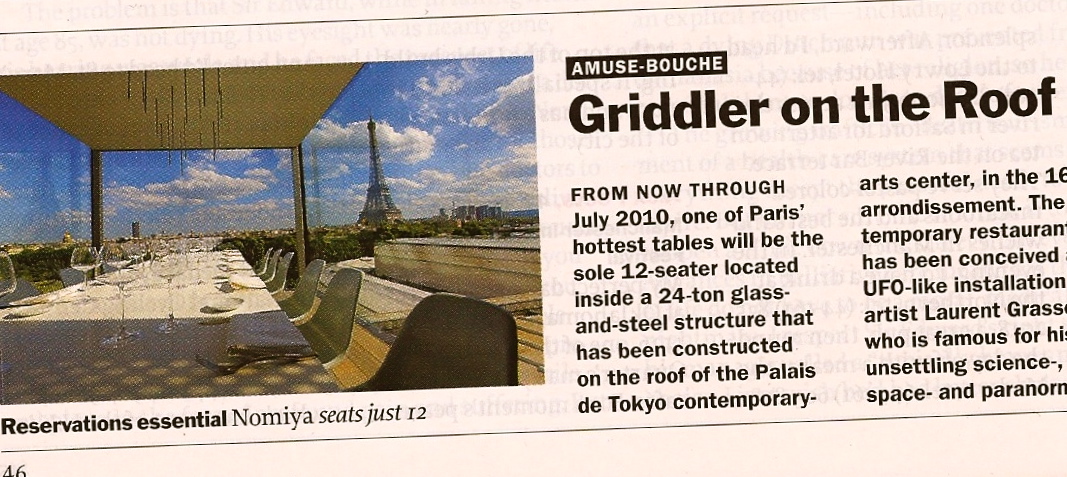
An art historian turned cook, Stassart can wax philosophical with the best of them, and proved to be quite the interview subject. (I’d never heard any chef, French or otherwise, describe his cuisine as the answer to resolving an ancient conflict between Apollo and Dionysus—god of the arts, reason and harmony and god of wine, ecstasy and disorder!) “Philosophically, we are trying to set aside this opposition between the body and soul,” he declared. “Pleasure is in the mind, too; it’s not only physical.”
To prove his point, he brought over what looked like various canapés or petit fours for me to sample. I soon learned that in Stassart’s cuisine, a dish is often not what it seems: a chocolate truffle when bitten turns out to be—surprise!—a chunk of parmesan cheese, dusted with cocoa. A piece of Turkish Delight topped with a strange looking little bud? Oh, that’s a Szechuan button. “Did you ever lick a battery as a kid?” Stassart enthused while I chewed, my tongue tingling and going numb. I nodded, indeed recalling the ‘flavor’ of a 9-volt coppertop from childhood—and quickly mentally cataloging Szechuan buttons among my gastronomic experiences not to be repeated.
So beyond the gags, was Stassart simply France’s most arrogant prankster chef, or had he really figured out some fundamental truths about how we eat today? The latter, I think. Whether he was toying with his guests’ expectations, or drawing on their childhood memories, in many playful ways Stassart was highlighting just how many decisions, processes and ideas are at work when it comes to eating—all before we ever take a single bite.
“We often think that a meal is simply something to nourish us, and taste but a sensation in your mouth. That isn’t the half of it. I believe we eat ideas—on mange du sens. Today, if you eat organic or fair trade food, on mange du sens…” When Stassart comes up with a dessert in January made from local winter vegetables (instead of importing strawberries from South America), “on mange du sens,” he said. So the meals we eat can really tell stories, “stories that relate to the major challenges of our era.” I was a bit taken aback to hear such an idea coming from the mouth of a French chef, perhaps because I’d always had this idea of French gastronomy as something not entirely connected with our present, as something existing almost on another plane.
I grew up in the Midwest, I didn’t travel to Europe until I was in my 20s, so like many Americans I came here for the first time expecting the France of Julia Child; I came with visions of blanquette de veau and coq au vin, of condescending maître d’s and militaresque kitchen brigades. I wanted to discover this France whose president once bemoaned, “How can you govern a country which has two hundred and forty-six varieties of cheese?” (It has hundreds more, in fact.) I was fascinated (and intimidated) by a country where wine was celebrated for having such boundless potential for complexity that it would perpetuate a system of geographical classification extending back more than a thousand years to monks who carved a tiny region like Burgundy into some 600 distinct climates capable of creating myriad individual wines. We imagine there’s something immutable about French gastronomy. We come to France to visit museums and churches and monuments… and to eat French cuisine.
And yet here was this chef telling me that French gastronomy wasn’t immutable, that it was evolving, that it was far from unconcerned by the challenges of the 21st century—and that you could taste it. And just in the months that followed that article, I found ample reason to believe that he was right.
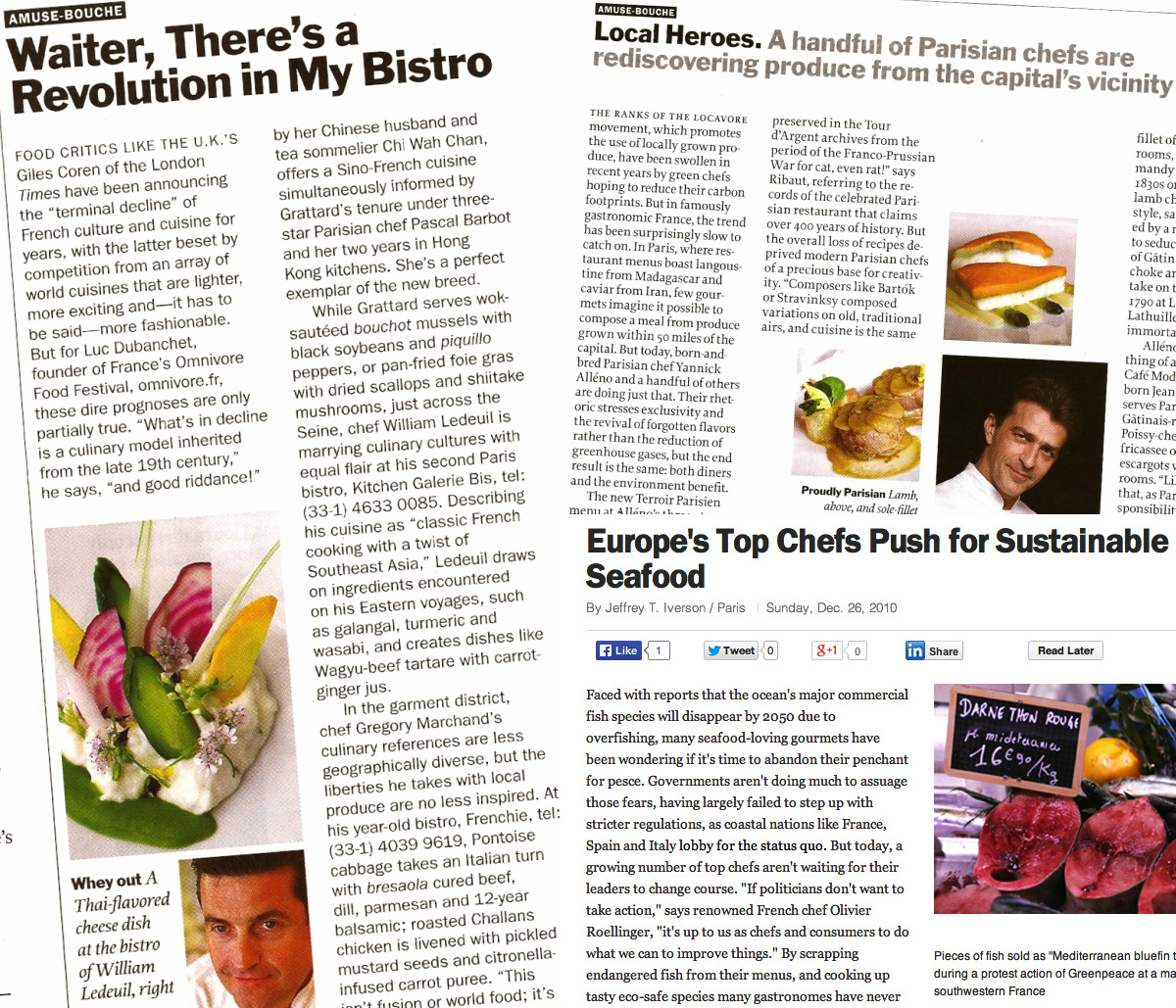 Soon I was covering stories such as the emergence of a locovore movement in Paris (precipitated by the dramatic loss of diversity in French produce and livestock species over the last century), a new push by French chefs for sustainable seafood in response to the crisis caused by irresponsible fishing practices, and a rejection of the old Escoffier school of fine dining by a new generation of globetrotting, multilingual French chefs who have begun reimagining their country’s cuisine in their image.
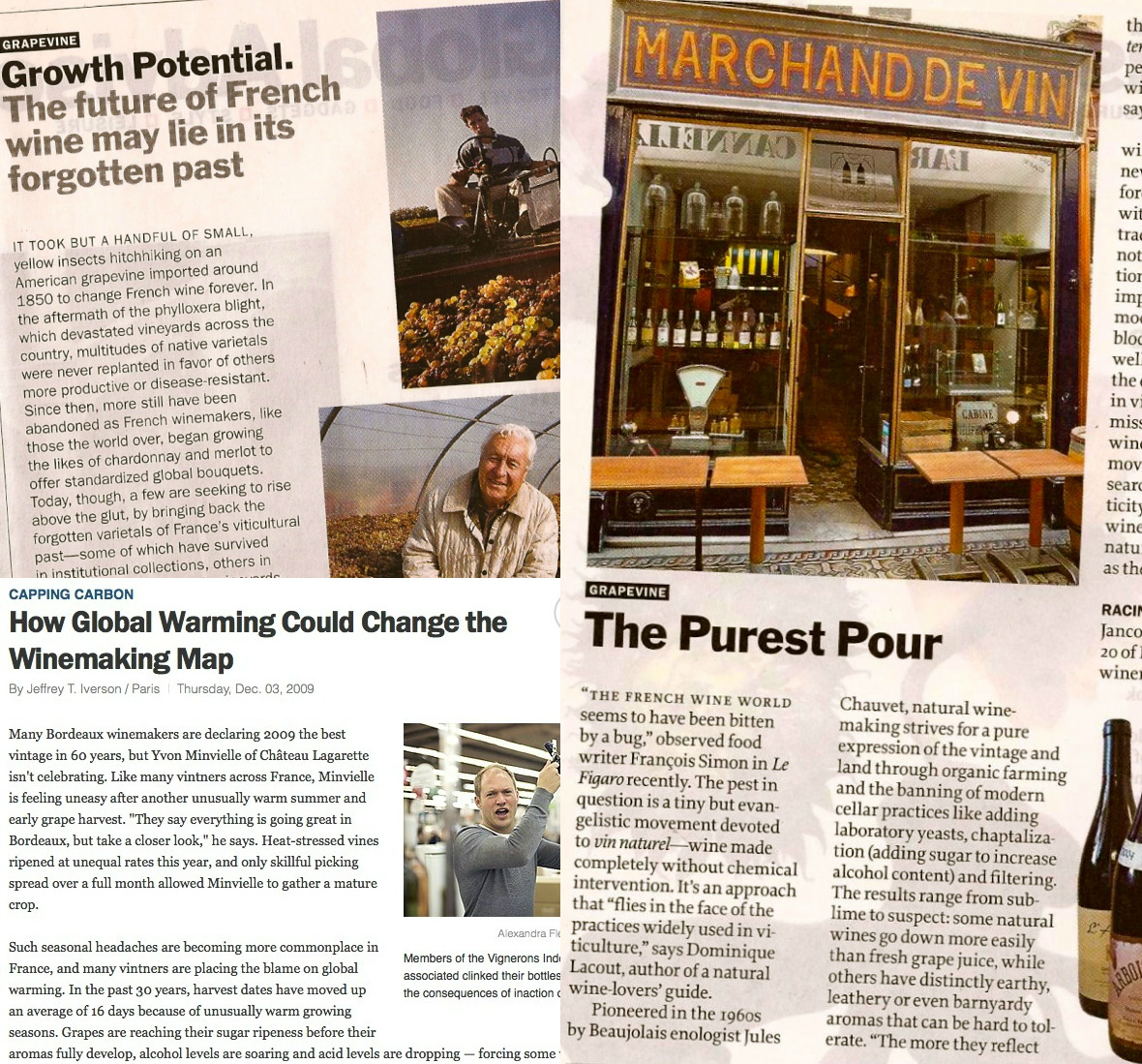
At the same time, I was writing about French vintners sounding the alarm
about climate change and the ruinous effect it’s starting to have on grape harvests, about vintners trying to save forgotten wine varietals, and about the emergence of the natural wine movement and the struggle against the industrialization of French wine. Even the revival of France’s beer brewing tradition, all but lost in the 20th century, seems to only be accelerating since I first started tasting the new wave of French microbrews around 2007.
These are the kinds of stories that impassion me today, that you’ll find throughout my portfolio of articles, and that I may occasionally blog about here as well. They are stories that certainly contradict the notion of a France whose food and wine culture is frozen in the past, or even in decline; but they are stories that also show that even the French can’t take for granted their 246 cheeses (or how ever many there are).
____________
Bordered by seas, ocean, mountain ranges and continental Europe, France is smaller than the state of Texas yet it is a country whose climate zones vary considerably, from oceanic and mountain, to continental and Mediterranean—from rainy, butter loving Brittany down to sunny, olive oil producing Provence. Buried seas and the collision and rifting of continents all have contributed to the country’s extraordinarily diverse geology. Viewed through such a lens, France’s enormous potential for farming myriad species of plants and animals, all in a single country, becomes manifest indeed.
In one of his memoirs, Souvenirs inédits, chef Auguste Escoffier mused (or rather gloated) about the reasons behind the seemingly inexorable ascendency of French gastronomy during his lifetime (1846-1935): “French soil has the privilege of producing, naturally and in abundance, the best vegetables, the best fruits, and the best wines in the world. France also possesses the finest poultry, the most tender meat, the most delicate and varied game. Its seacoasts provide it with the most beautiful fish and crustaceans. Thus, it is completely natural for the French to become both gourmands and great cooks.”
Today, what’s important is not whether the poulet Bresse is the finest or only one of the finest chickens to ever walk the earth; it no longer matters how rich France’s history, its soil, or its potential may be; what matters is what comes next for France, at a time when the savoir-faire and great diversity of products, vegetables, animals and wine that are the foundation of a country’s gastronomy are at risk as never before. I want to celebrate the passionate, innovative men and women who are doing something about that, and who are writing the next chapter of French gastronomy, all the while remaining irrefutably, deliciously français.
—Jeffrey T Iverson
© Jeffrey T Iverson, 2025. Unauthorized use and/or duplication of this material without express and
written permission from this blog’s author and/or owner is strictly prohibited. Excerpts and links may be
used, provided that full and clear credit is given to Jeffrey TIverson with appropriate and specific
direction to the original content.
 Jeffrey T Iverson .com